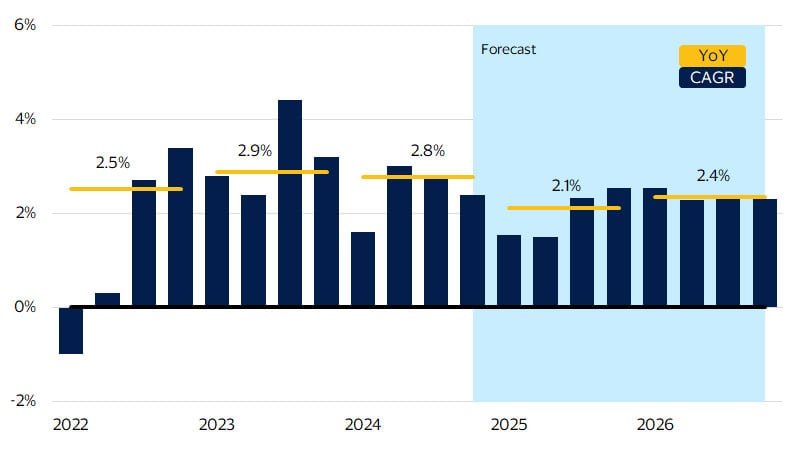
A GDP report can change after its initial release even though the quarter being measured is already over. The update reflects a change in the estimate, not another quarter of economic activity. Keeping those concepts separate prevents a common headline-reading error.
Early estimates use incomplete information
BEA explains in its GDP documentation that early estimates use source data that can be incomplete or subject to revision. Later estimates incorporate more detailed information. Its revision tables compare release versions for GDP and its components.
This is why a research note needs both a reference quarter and a release date. “Second-quarter growth” alone does not identify which estimate the writer used.
A hypothetical revision
Suppose an initial report estimates annualized growth of 2.0% for a quarter. A later release changes that estimate to 2.4%. The revision is an increase of 0.4 percentage point.
It is not an extra 0.4% of growth that occurred after the quarter ended. Nor is it a comparison between that quarter and the next. The two figures are different estimates of the same period.
Compare matching release versions
Imagine a chart containing a newly revised figure for Country A and an early figure for Country B. Their reporting status differs even if the quarter labels match. That does not make comparison impossible, but the difference should be disclosed.
For a reproducible worksheet, keep the value originally observed and the updated value in separate columns. Overwriting everything without a date can make an earlier analysis impossible to reconstruct.
Look below the total
- Identify which expenditure components were revised.
- Separate the revision from the latest quarter-to-quarter movement.
- Record whether growth is annualized or measured on another basis.
- Check whether earlier periods were updated too.
One component can be revised upward while another moves downward, leaving the total nearly unchanged. The total and its composition therefore answer different questions. Read the release explanation before deciding what the update changes about the economic picture.
Sources
BEA: GDP Revision Information; BEA: Explanation of GDP Estimate Updates.
Featured image: Photo by Jakub Żerdzicki on Unsplash.